Ayurvedic Proctology
Ksharkarma Therapy (Caustic Therapy)
A safer, gentler alternative to surgery & thermal cautery
Kshara is an alkaline, caustic substance derived from the ashes of medicinal plants. It stands out among sharp and subsidiary instruments — excelling in excision, incision and scraping. Kshara Karma serves as a valuable substitute for surgical instruments, offering a safe option for patients averse to surgery thanks to its ease of performance, cost-effectiveness, absence of complications, proven efficacy and convenience of not requiring hospital admission.
Main Ingredients
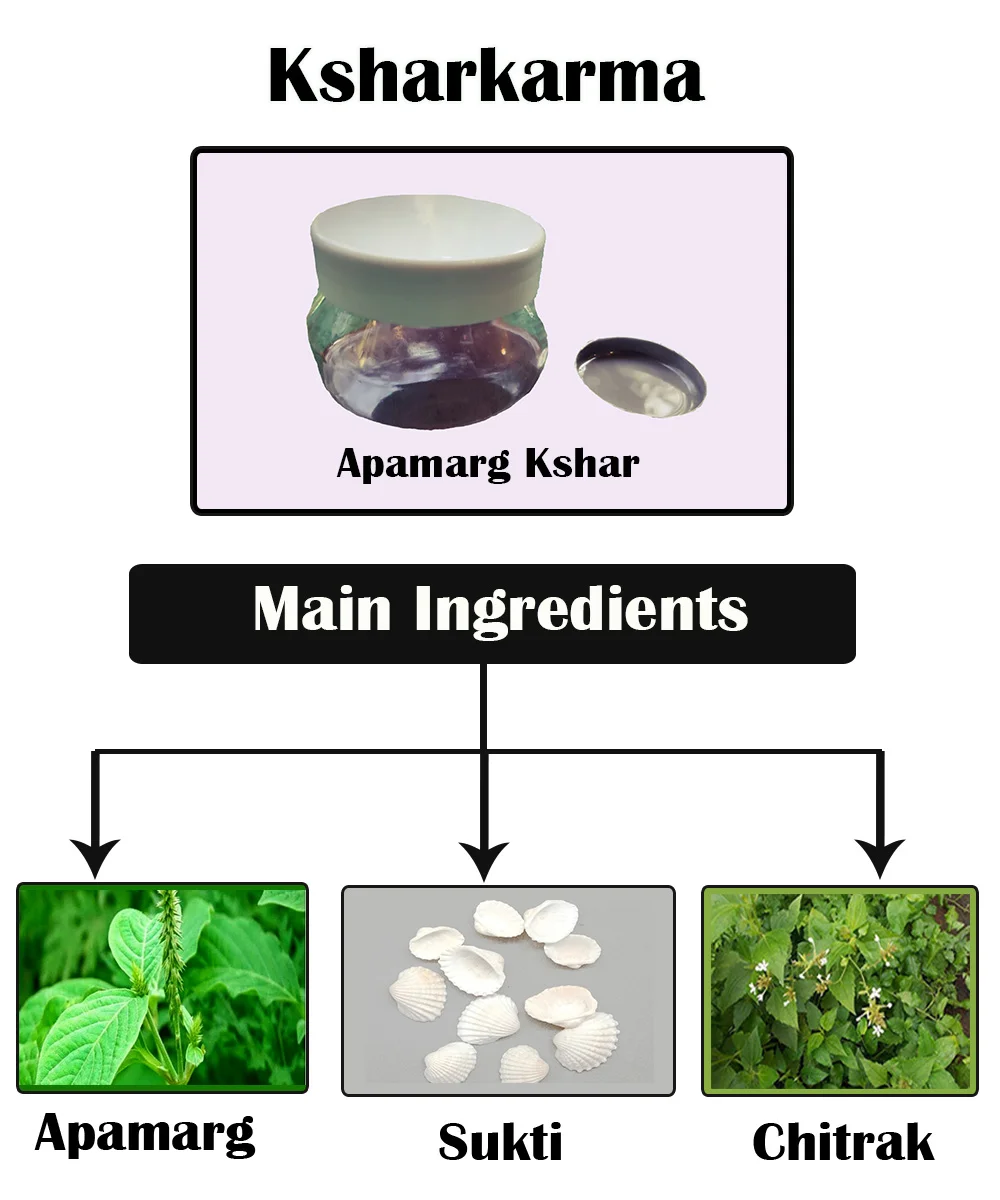
What goes into Kshara?
The primary preparation — Apamarg Kshar — is derived through a meticulous Ayurvedic process using medicinal plants and natural minerals. Three of its foundational ingredients are:
Apamarg
Achyranthes aspera leaves
Sukti
Calcined seashells (limestone)
Chitrak
Plumbago zeylanica root
Classification
Types of Kshara
Kshara is classified on the basis of administration and concentration.
01
Pratisaaraneeya Kshara
External application
02
Paneeya Kshara
Internal administration
03
Mild (Mridu)
Low concentration
04
Moderate (Madhyama)
Medium concentration
05
High (Teekshana)
Highly concentrated
Watch
Discover the alternative to surgery with Kshara
A short explainer by Dr. Kamthe on how Kshara therapy works.
Preparation
The Five-Step Ayurvedic Process
A carefully controlled process transforms 16 medicinal plants and natural limestone into therapeutic Kshara.
Burning the Herbs
Gather 5 kg of the entire plants of Apamarga, Palash, Kutaj, Aragwadh, Arka, Snuhi, Patala, Chitrak, Karveer, Saptaparna, Agnimanth, Ashwakarna, Tilvak, Paribhadra, Kadali and Nimb. Dry them and burn them. Collect 500 g of the resulting ash.
Filtration (×21)
Mix the ash with approximately 3 litres of water and filter the mixture 21 times. The resulting filtrate is clear, resembling the colour of cow's urine.
Mridu Kshara
Heat the filtrate gently until the liquid reduces to one-third of its original quantity. This is the mild concentrate — Mridu Kshara.
Madhyama Kshara
Add 50 g of red-hot Shukti (limestone) to the filtrate and stir continuously until it again evaporates to one-third of its volume. This stage is termed Madhyama or moderate Kshara.
Pratisaraneeya Teekshana
Add 5 g of Chitraka moola kalka (Plumbago zelanica) and continue heating. This yields a thick solution — the highly concentrated Pratisaraneeya Teekshana Kshara. Store in an airtight container.
Microscopy of Prepared Kshara
pH measured at 13.3
Microscopic examination of prepared Kshara reveals fibrous and sclereidal tissues along with polygonal crystals of varying sizes. After decanting the supernatant liquid, the Kshara paste exhibits loss on drying. The dried, moisture-free Kshara powder is analyzed for total ash and acid-insoluble ash content — and the supernatant liquid is measured at a pH of 13.3, confirming its strong alkaline therapeutic property.
Indications
Where Kshara Therapy Helps
Paneeya Kshara (Internal)
- Worms
- Indigestion
- Urinary calculus
- Skin diseases
- Obesity
Pratisaraneeya Kshara (External)
- Internal haemorrhoids (Piles)
- After fistulectomy
- Rectal prolapse
- After excision of pilonidal sinus
- After incision & drainage of anorectal abscess
- Infected wounds & fissures
Application of Kshara
Clinical Use in Anorectal Conditions
Tap a condition to see how Kshara therapy is applied.
Application Detail
Internal Haemorrhoids / Piles
The patient undergoes local or spinal anaesthesia before the introduction of a lubricated slit proctoscope into the anus. Kshara is then applied over the internal pile mass and left for 1-2 minutes — or until the pile mass adopts a reddish-black colour (Pakwa Jambu Phala Varna). The pile mass is cleansed with mild acidic liquid to neutralize the Kshara after the effective burning of piles. This procedure is replicated for other piles. Subsequently, a rectal pack containing Yashtimadhu taila or ghrita is applied.
Advantages
Why Patients Choose Kshara Therapy
Treatment Protocol
Ksharkarma Procedure Steps
A structured three-phase approach ensuring safety, precision, and optimal recovery.
Purva Karma
Pre-Procedure Preparation
- Patient assessment and diagnosis.
- Explain the procedure and obtain consent.
- Keep all required instruments ready and sterilized.
- Light diet is usually advised before the procedure.
- Bowel preparation/enema may be given if required.
- Clean and prepare the treatment area.
- Position the patient appropriately (commonly lithotomy position for anorectal procedures).
Pradhana Karma
Main Procedure
- Administer local or spinal anesthesia as required.
- Clean the operative area with antiseptic solution.
- Insert a proctoscope or expose the affected area.
- Identify the lesion (piles, fistula, wart, etc.).
- Apply the Kshara (alkaline paste) directly to the affected tissue.
- Allow it to act for the prescribed duration (usually a few minutes).
- Observe tissue changes indicating adequate action.
- Neutralize the Kshara using natural acidic neutralizing agent.
- Wash the area thoroughly.
- Apply dressing or rectal packing if needed.
Paschat Karma
Post-Procedure Care
- Monitor the patient for pain or bleeding.
- Provide prescribed medicines and wound care instructions.
- Advise sitz baths/warm water cleansing if indicated.
- Recommend a high-fiber diet and adequate hydration.
- Schedule follow-up visits for assessment and healing.
Advanced Care
MIPT – Minimal Invasive Piles Treatment
A modern, patient-friendly approach that combines scientific precision with Ayurvedic support.
At Dr. Kamthe's Piles Clinic, piles treatment is now more comfortable, advanced, and patient-friendly with MIPT – Minimal Invasive Piles Treatment. Many patients delay piles treatment because they fear surgery, pain, cuts, bleeding, and long recovery time. However, with modern treatment methods, piles care has become more precise, comfortable, and recovery-focused. MIPT – Minimal Invasive Piles Treatment is an advanced approach designed to treat piles with minimum discomfort and faster recovery support. It focuses on patient comfort, precision treatment, and quicker return to daily routine. At Dr. Kamthe's Piles Clinic, we combine scientific treatment methods with Ayurvedic support to provide a holistic and patient-friendly approach for piles, fissure, and related anorectal problems.
Minimal Pain
Designed to reduce discomfort during and after treatment.
No Cuts
A minimally invasive approach that avoids major surgical cuts.
Faster Recovery Support
Helps patients return to their normal routine sooner.
Patient-Friendly Procedure
Comfort-focused treatment with expert care and guidance.
Scientific + Ayurvedic Approach
Modern medical techniques supported with Ayurvedic care wherever suitable.
Video Testimonials
Hear it from our patients
Real stories of relief, recovery and renewed comfort — shared by our patients.
Considering a non-surgical alternative?
Speak with our specialists to find out if Ksharkarma therapy is suitable for your condition. Personalized evaluation, safe procedures, and time-tested results.